
Buying a Denver Home: Video Library
If you’re like most home buyers, the prospect of buying a new home can seem overwhelming—even scary. It doesn’t have to be that way.
The Oddo Group has a passion for educating people. Our goal is to give you the information you need to know so you can make your journey toward Denver home ownership smooth.
As always, if you have questions or need loan assistance, feel free to call or email us.
303-961-6906
michelle.oddo@goluminate.com
3 Housing Market Questions
3 Housing Market Questions Everyone’s Asking This Season
Holiday season conversations always seem to circle back to one thing: the housing market. Whether you’re chatting at a family gathering, the office holiday party, or catching up with friends, people are wondering what’s really going on, especially first-time buyers trying to make smart financial decisions.
To help you feel confident (and maybe even become the real estate expert at the table), here are the top three housing market questions people are asking right now with clear, fact-based answers.
1. “Will I even be able to find a home if I want to move?”
Short answer: Yes, and more than you could a year or two ago.
Housing inventory has been rising, giving buyers and sellers more breathing room. Realtor.com reports more than one million homes on the market for six straight months, something we haven’t seen since 2019.

What this means for buyers like you:
- More homes to choose from
- Less competition for every listing
- More time to compare and make confident decisions
If you paused your search last year because nothing fit your needs, this is a very different landscape. Homes aren’t selling in minutes anymore, and that gives you the time and space to evaluate your options without pressure, especially if you’re a first-time buyer.
2. “Will I ever be able to afford a house?”
Here’s the good news: affordability is finally improving, and not just by a little. Two major shifts are helping first-time buyers get back into the game:
- Mortgage rates have been trending down
- Home price growth has slowed to a more normal pace
Together, these changes can reduce a monthly mortgage payment by hundreds of dollars compared to earlier this year.
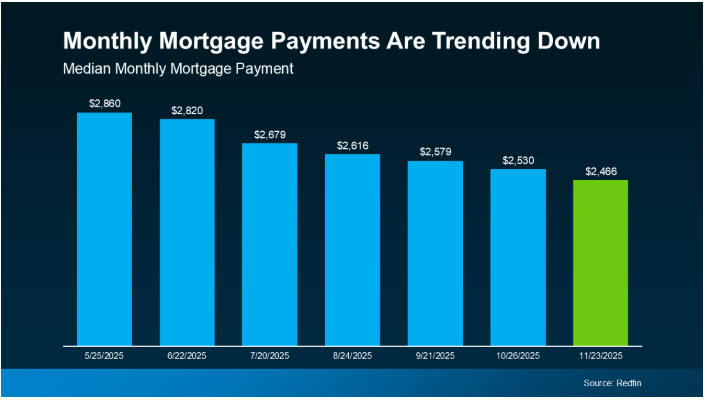
Buying a home is still a meaningful financial step, but the numbers are becoming more workable for everyday buyers, especially those who are budgeting carefully and comparing payment scenarios.
3. “Should I wait for home prices to come down?”
This comes up every year, but here’s the data-backed reality: a major nationwide price drop isn’t likely.
Even though inventory is growing, it’s not high enough to push prices down significantly. And unlike 2008, today’s homeowners have strong equity and solid financial stability.
Local markets vary, but nationally, economists surveyed by Fannie Mae expect home prices to keep rising, just at a slower pace.
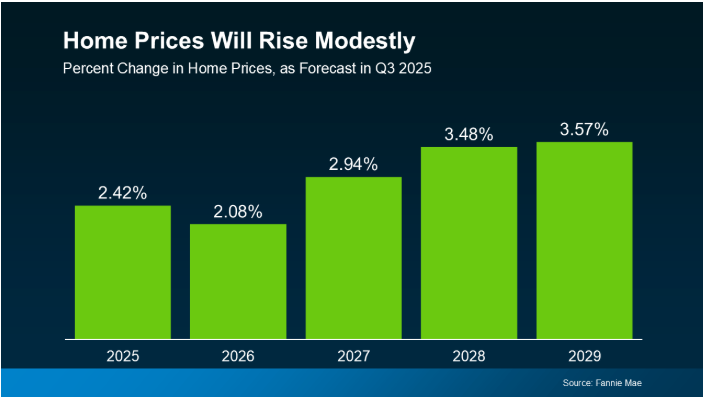
Why waiting rarely works:
Trying to time the housing market is like trying to time the stock market: even the pros get it wrong. Historically, those who stay in the market build more long-term wealth than those who wait for the “perfect moment.”
If you’re renting, waiting may mean you’re simply paying more later for the same home.
Bottom Line
The housing market can feel overwhelming, especially when everyone has an opinion and begins arguing over the holiday ham. But the real questions come down to your goals, your budget, and your timeline.
If you want clarity based on today’s numbers and not headlines or rumors, let’s connect. We’ll walk through your options, look at real data for your local market, and help you build a confident plan for your next step.
Let’s Chat.
Are you ready to navigate the real estate market with confidence? Contact us today to discuss how you can take advantage of current market opportunities.
Michelle Oddo
Mortgage Wealth Advisor, The Oddo Group
michelle.oddo@goluminate.com
(303) 961-6906

50-Year Mortgage
Let’s Talk About 50-Year Mortgages
In early November, President Trump signaled plans to develop a 50-year mortgage with the goal of expanding access to homeownership. Trump posted on Truth Social with a graphic showing “Great American Presidents,” including Franklin D. Roosevelt, whose New Deal housing reforms helped pave the way for the modern 30-year mortgage, and himself, suggesting he will develop a 50-year version.
“A Financial Frankenstein’s Monster”
Long ago, 30-year fixed-rate mortgages were described as “a financial Frankenstein’s monster” from the perspective of lenders.
And while the history is fairly complicated, 30-year mortgages essentially date back to the Depression era. Fundamentally, 30-year mortgages are a government invention.
The government-sponsored enterprises Fannie Mae and Freddie Mac purchase mortgages from private lenders, allowing them to offload the risks associated with lending large sums of money for long periods of time (at a fixed interest rate).
Some believe that the government’s support is what made 30-year mortgages a legitimate option, and ultimately led to their sustainability and popularity. But could that future be guaranteed for the 50-year mortgage?
Mortgage Comparison Analysis
30 year versus 50 year mortgage costs by city


Looking at the Numbers
A UBS analysis found that a 50-year mortgage results in total interest payments equal to roughly 225% of the home’s price, which is more than twice the level under a 30-year loan.
UBS also noted that with a 50-year term, borrowers would have paid down only about 11% of the principal after 20 years, highlighting how slowly equity builds over such an extended period.
The length of the 50-year loan makes it riskier for banks, which would likely raise interest rates, as well.
Better Solutions May Lie on the Supply Side
Regardless, there is still one critical issue when it comes to housing affordability — the lack of supply of homes.
States like California and cities like New York have recently passed legislation and regulatory changes to allow builders to build homes faster with less red tape.
And there’s still the raw cost of homebuilding to consider.
Products such as steel, lumber, concrete, copper and plastics that go into home construction are now subject to tariffs under President Trump. Further, many construction jobs were being done by undocumented workers, particularly in the Southwest, where deportations are impacting the ability for homebuilders to find enough labor to build homes.
So, before long-lasting, significant change can be made within the housing industry, the argument can be made that we need to get better at increasing (and maintaining) our supply levels first.
“You Can’t Take Your Mortgage With You If You Sell Your House”
Unlike many other countries, in America, you can’t take your mortgage with you if you sell your house. So when people sell their house and move, they end their mortgages.
And that plays an important role in dissecting the potential reality of 50-year mortgages.
The typical American homeowner spends less than 12 years in their home, according to a recent Redfin analysis of the U.S. Census data. And that’s actually high compared to recent history. Back in the early 2000s, Americans typically spent around seven years in their homes.
Daryl Fairweather, chief economist at Redfin, believes that “ most people will not have that 50-year mortgage product for that length of time.”
“I think in a world where this product exists, a lot of people might sign up for it initially and then try to refinance later.”
One benefit that would be true for 50-year mortgages, as is the case with all fixed-rate mortgages, is the ability to freeze rates and then refinance later if the opportunity arises is a huge benefit to homebuyers. It offers predictability on your housing costs. And, especially nice, a fixed-rate mortgage basically shields you from inflation and its accompanying higher interest rates.
The Bad and The Ugly of Long-Term, Fixed-Rate Mortgages
Any long-term, fixed-rate mortgages come with costs: they tend to have higher interest rates than adjustable rate mortgages and you have a longer period upfront paying interest and not actually paying down your loan much.
But that fact is amplified when you apply it to a 50-year timeline.
If the housing market gets dicey and prices start plummeting, having a large outstanding loan at a fixed interest rate could create serious problems.
Long-term, fixed-rate mortgages increase the probability that you can go underwater on your home, a situation where you owe more on your house than it’s worth.
So, if you sell, it means the money you get won’t cover your debt. It gets much harder to refinance, meaning you’re stuck with a higher interest rate than you could otherwise get in a situation where the housing market tanks.
Not an ideal situation, especially if we speculate on broad-term adoption of 50-year mortgages.
Closing Thoughts
Our top priority is to educate and empower our clients. While the 50-year mortgage is currently nothing more than spirited speculation, products such as 30-year fixed and adjustable-rate mortgages are alive and well.
Informed decisions are strong decisions. At Luminate Bank, we’re here to help you before, at, and far beyond the closing table to build concrete strategies for one of the biggest investments of your life.
If you’re ready to purchase or refinance your next home, don’t hesitate to give us a call or visit us online today.
Let’s Chat.
Are you ready to navigate the real estate market with confidence? Contact us today to discuss how you can take advantage of current market opportunities.
Michelle Oddo
Mortgage Wealth Advisor, The Oddo Group
michelle.oddo@goluminate.com
(303) 961-6906
No More Pennies?
No More Pennies? Here’s How the Phaseout Will Affect Cash, Banking, and Payments
If you’ve been noticing fewer pennies in your pockets lately, it’s not your imagination. The U.S. Treasury has officially begun phasing out the penny, with production expected to end entirely by early 2026. After more than 160 years in circulation, the country’s smallest coin is finally stepping off the stage.
With more than 114 billion pennies currently circulating, the government determined that it was time to stop producing new ones due to rising costs, stagnant circulation, and the increasing shift toward digital payments.
While it may seem like a tiny change, there will be meaningful ripple effects for cash transactions, banks, and even your day-to-day budgeting.
Why Is the Penny Going Away?
Over the last decade, the cost of making a penny has become more expensive than the penny is actually worth. Combine that with slowing circulation and a national move toward electronic payments, and the math simply no longer supports keeping the penny in production.
As inventories shrink, the Federal Reserve has already begun limiting penny distribution at certain regional centers. Some distribution sites (including locations in Minnesota) have suspended penny orders as their supplies deplete.
How Will Prices and Payments Change?
Here’s the part most people are curious about: Will things get more expensive?
According to experts, most retailers are expected to use a standard rounding rule when handling cash purchases without pennies:
• Ending in 1, 2, 6, or 7 cents → rounded down
• Ending in 3, 4, 8, or 9 cents → rounded up
• Ending in 0 or 5 cents → no rounding
This rounding applies only to cash transactions. Digital transactions (e.g. debit cards, credit cards, online payments, ACH, and mortgage payments) still settle to the exact cent.
It’s estimated that rounding could cost consumers an average of a few dollars per year, which should be more of an inconvenience than a major financial hardship.
What This Means for Luminate Bank Customers
As a digital-first bank, most of the way our customers move money won’t feel any different. But as the country transitions away from pennies, here are a few things you may notice over time and how Luminate Bank will help keep everything smooth and predictable.
- Cash transactions may eventually round to the nearest nickel.
If and when rounding becomes the standard across retailers and financial institutions, you may see small adjustments on cash-only transactions. Digital payments (like debit cards, mobile wallets, and online banking) will continue to settle to the exact cent.
We’ll share updates if any rounding practices become necessary in our branches. - Changes in coin availability will vary by region.
Some Federal Reserve distribution centers have already begun limiting penny orders as inventories decline nationwide. This may mean that penny rolls become harder to get across the banking industry, not just at Luminate. We’ll monitor supply at the national and local level and keep customers informed if availability changes. - Digital payments continue to offer a seamless alternative.
Because electronic payments are not affected by rounding, more customers may choose tap-to-pay, online transfers, or debit card purchases. As a digital-forward bank, we’ll continue expanding and improving these tools to make managing money simple, pennies or no pennies. - We’ll communicate clearly before anything changes.
Whether the shift happens gradually or quickly, we’ll use email, website updates, social posts, and branch signage to help customers understand what’s changing, why it’s happening, and what it means for their day-to-day banking.
What This Means for Mortgage Customers
The good news: your mortgage world doesn’t change much.
For mortgage customers (buyers, homeowners, and real estate professionals) the penny phaseout has very minimal impact. But here’s what you should know as the national transition continues:
1. Your mortgage payments won’t change. Mortgage payments, escrow totals, and statements are calculated down to the exact cent. Even if pennies disappear from circulation, mortgage servicing systems, ACH withdrawals, and online payments will still reflect precise amounts.
2. Closing costs, disclosures, and settlement statements remain exact.
Real estate transactions are governed by strict federal accuracy requirements, meaning lenders and title companies can’t round numbers for convenience. All closing documents (including the Loan Estimate and Closing Disclosure) will continue to use precise totals, even as small coins become less common.
3. Cash interactions during closing may look slightly different.
In the rare instances where cash is exchanged in person, like with small adjustments or reimbursements, nearest-nickel rounding could eventually apply industry-wide. Most title companies already prefer certified funds, so the practical impact for buyers and sellers will be minimal.
4. Digital payments keep everything simple.
Most mortgage customers already pay online or via auto-draft, and nothing changes there. As a digital-first bank, we’ll continue investing in tools that help you manage payments, documents, and communication without worrying about rounding or coin availability.
5. We’ll stay aligned with industry guidance and keep you updated.
Luminate Bank remains plugged into federal, state, and industry updates as the penny phaseout moves forward. If there are any mortgage-specific recommendations from regulators, we’ll evaluate them carefully and communicate clearly with our customers and partners.
What Businesses Should Know
If you’re a business owner, especially one that takes cash, guidance from the Federal Reserve suggests preparing now:
• Train staff on rounding rules
• Prepare a brief explanation for customers
• Promote digital payments to avoid rounding altogether
• Monitor your coin inventory as penny supply varies by region
What’s Next?
As the penny phaseout continues nationwide, one thing won’t change: our commitment to keeping you informed, empowered, and prepared for whatever comes next.
We expect more updates from the Treasury and Federal Reserve throughout 2025 as inventories decline and rounding becomes more common. For now, there’s nothing customers need to do; just know the penny is on its way out, and we’ll help make the transition smooth and predictable.
You can count on us to help you navigate this transition with confidence—pennies or no pennies.
Let’s Chat.
Are you ready to navigate the real estate market with confidence? Contact us today to discuss how you can take advantage of current market opportunities.
Michelle Oddo
Mortgage Wealth Advisor, The Oddo Group
michelle.oddo@goluminate.com
(303) 961-6906
Buying a Home Without a Credit Score?
Buying a Home Without a Credit Score? DU’s New Rules Make It Possible
Big changes are coming to the mortgage world, and this one could reshape how buyers qualify for a conventional loan.
Fannie Mae announced that beginning November 16, 2025, Desktop Underwriter® (DU) will no longer require a minimum credit score for loan eligibility. Instead of relying on the traditional 620-minimum rule, DU will evaluate homebuyers using a holistic, risk-based assessment.
This shift impacts first-time homebuyers, credit-invisible buyers, and realtors helping clients navigate mortgage requirements. And yes, it could open the doors to homeownership for thousands of people who previously couldn’t qualify.
Let’s break it down.
What’s Changing in DU? (Simplified for Buyers & Realtors)
Under today’s rules, DU needs someone on the loan with a 620+ credit score. No exceptions. But beginning in November 2025, DU won’t need a minimum score at all.
Instead, it will evaluate risk using a combination of:
- Credit history and payment patterns
- Income stability
- Savings and assets
- Property factors
- Overall borrower + loan profile
This means your financial story matters more than one three-digit number, which is a shift that aligns with Luminate Bank’s mission to make homeownership more accessible, more transparent, and more human.
If You Don’t Have a Credit Score, You’re Still in the Game
A lot of responsible adults pay everything in cash or online and never establish traditional credit. Under this new DU update:
- You can apply even with no credit score
- DU may ask your lender to build a nontraditional credit profile (rent, utilities, insurance, etc.)
- DU may require homebuyer education
- These requirements are no longer tied to whether a credit score exists
In other words, borrowers who’ve been shut out of the system simply because their lives don’t revolve around credit cards now have a path forward.
Why Fannie Mae Is Doing This
This update is part of DU Version 12.0, and it reflects a shift we’re seeing across the financial world:
- More inclusive credit evaluation: Scores aren’t going away, but they’re no longer the gatekeeper for eligibility.
- A fairer approach for younger or credit-invisible buyers: Millions of Americans have thin credit files despite strong payment histories.
- A move toward modern, data-rich underwriting: Income, cash flow, and consistent housing payments often tell the better story.
Key Dates You Need to Know
- November 15, 2025: All other DU updates take effect for loans submitted or resubmitted.
- November 16, 2025: Minimum credit score requirements are officially removed for new DU casefiles.
So, if you’re eyeing a home purchase in late 2025 or early, timing could play in your favor.
What About Pricing, Mortgage Insurance, and Investor Guidelines?
This part still involves some moving pieces, but here’s what we know:
Pricing & LLPAs
The pricing structure already accounts for lower credit tiers (like “FICO ≤ 639”), so we’re not expecting major pricing shocks right away.
Mortgage Insurance (MI)
MI companies are still reviewing this change. Their reactions may influence:
- MI pricing
- Credit documentation expectations
- How they handle loans with no score
Investors
Investors may introduce overlays or additional credit history guidelines. We won’t know specifics until they publish updates.
At Luminate, we’ll keep a close eye on these responses so we can guide buyers and partners with absolute clarity, not guesswork.
Bottom Line: The Credit Score Is No Longer the Gatekeeper
Fannie Mae’s removal of minimum credit score requirements in DU is a major win for borrowers who’ve been overlooked by traditional credit models. It makes underwriting more inclusive, more flexible, and more reflective of real-world financial behavior.
As MI companies and investors finalize their guidelines, we’ll share updates to keep our buyers, realtors, and partners ahead of the curve.
And if you’re thinking about buying a home in the next year? This change could open doors that weren’t open before.
Let’s Chat.
Are you ready to navigate the real estate market with confidence? Contact us today to discuss how you can take advantage of current market opportunities.
Michelle Oddo
Mortgage Wealth Advisor, The Oddo Group
michelle.oddo@goluminate.com
(303) 961-6906
Housing During a Government Shutdown
What the Numbers Say About Housing During a Government Shutdown
With the current and ongoing federal government shutdown, you may be wondering: “Does this mean the housing market completely stops in its tracks?”
In short, no; the market still keeps working.
Homes continue to be listed, contracts continue to be signed, and closings still happen. But what does change is that certain federal-processes may start to slow down, and this uncertainty can affect timing, decision-making, and opportunity for both buyers and sellers.
What’s Happening Now
When the government is shut down, many federal agencies either reduce operations or pause non-essential activity. In the housing finance world, that means there are a few specific areas may face delays:
- Loans backed by federal programs such as Federal Housing Administration (FHA), Department of Veterans Affairs (VA), or United States Department of Agriculture (USDA) may encounter slower processing. These programs represent a notable portion of overall mortgage origination.
- Insurance and regulatory approvals, such as those tied to the National Flood Insurance Program (NFIP), may pause or backlog. Since many closings in flood-prone areas rely on flood insurance certification, this can stall some transactions.
- Because of the uncertainty, some buyers and sellers may delay moving forward, which can create short-term shifts in activity. Data indicates that when shutdowns occur, mortgage applications and endorsements drop.
Importantly, none of this means the housing market is frozen. It means you might see slight delays, more caution, or short-term adjustments.
What History Suggests, and Why This Time Might Be Different
Looking back at previous shutdowns (e.g. the one at the end of 2018 that lasted 35 days), the housing market proved remarkably resilient.
Data from the National Association of Realtors (NAR) shows that existing home sales slowed slightly for about two months before rebounding quickly once the government reopened.

The dip you see in the orange bars wasn’t due to normal seasonality; it aligned exactly with the shutdown period. Once operations resumed, sales picked back up almost immediately as delayed closings cleared the pipeline.
While no two shutdowns are exactly alike, past patterns suggest any current slowdown is likely temporary: hopefully more of a pause than a problem.
How This Affects You Right Now
No matter where you are in the homeownership journey—be it a purchase or sale, or just starting to think about making a move—here’s what you should keep in mind:
- If you’re closing on your home soon and your transaction involves an FHA/VA/USDA loan or flood insurance, build in extra buffer time. A closing date might shift by a few days (or more) while the shutdown persists.
- If you’re just starting your home search, this could be a strategic moment for you. With many buyers pausing their search activity, there’s less competition in the market, meaning motivated sellers might be more responsive, and you might find more negotiating room.
- If you’re selling, keep in close communication with your agent and lender about deadlines and documentation; prompt action may help smooth potential slowdowns.
- If you’re purely a general buyer or seller (not needing a federally backed loan or special insurance), the market still functions. The impact is more in timing and mindset than market fundamentals.
Bottom Line
The ongoing government shutdown does not mean the housing market halts; it just means some parts of the process may move a little slower, and the uncertainty adds an element of risk. Historically, markets return to their rhythm once federal services resume.
If you’re wondering how this might impact your timeline, especially at Luminate Bank, we’d love to talk and help you map out your next steps with clarity and confidence.
Let’s Chat.
Are you ready to navigate the real estate market with confidence? Contact us today to discuss how you can take advantage of current market opportunities.
Michelle Oddo
Mortgage Wealth Advisor, The Oddo Group
michelle.oddo@goluminate.com
(303) 961-6906
Pricing Costing You Your Move
Don’t Let Unrealistic Pricing Cost You Your Move
These days, getting your list price right is more than a real estate tactic, it’s a financial strategy that impacts your home equity, future affordability, and long-term goals.
It’s easy to think: “Let’s price high and see what happens.” But in today’s shifting market, that strategy can backfire fast, costing you time, leverage, and in some cases, your next move entirely.
The Hidden Cost of “Testing the Market”
Today, there are more listings, fewer bidding wars, and smarter buyers who are shopping within tighter budgets. They’re looking closely at mortgage rates, monthly payments, and the total cost of ownership, not just sticker price.
As Lisa Sturtevant, Chief Economist at Bright MLS, explains:
“Buyers will have more leverage in many, but not all, markets. Sellers will need to adjust price expectations to reflect the transitioning market.”
That means the “test-the-market” mindset often leads to longer days on market, price reductions, and lost buyer confidence.
But here’s the good news: even after accounting for a market adjustment, the average homeowner has built significant equity. According to the Federal Housing Finance Agency (FHFA), home values have increased by 54% over the past five years.
Financial Reality Check:
You might not sell at the peak price your neighbor got, but odds are you’ll still walk away with a healthy profit, especially if you’ve been in your home for more than a few years.
Why Overpricing Can Freeze Your Finances
When your home sits on the market too long, it doesn’t just stall your plans, it also impacts your financial momentum:
- Carrying costs add up. Each extra month means another mortgage payment, utilities, insurance, and property taxes.
- Your buying power shrinks. If rates rise while you wait to sell, your next mortgage could cost more.
- Your home equity is tied up. That’s money you can’t use for a down payment or to strengthen your next move.
According to a recent JBREC & Keeping Current Matters survey, 54% of agents say more homes are being delisted because sellers didn’t receive the offers they hoped for.
“Sellers holding onto high price expectations is the leading reason they are delisting their homes.” – JBREC & KCM Survey
And Bright MLS data echoes that finding:
“Sellers are delisting after having their home on the market and finding they are not getting the price they hoped for.”
When that happens, you’re not just losing buyer interest, you’re losing financial opportunity. Every extra month off the market delays your next purchase and can even affect your loan approval timeline.
The Smart Seller’s Strategy
If your goal is to move closer to family, upsize, downsize, or relocate for work, pricing strategically is key to keeping your financial goals on track.
Here’s how to do it:
- Work with a local agent who knows real-time buyer behavior, not just last quarter’s comps.
- Ask your lender for an updated net proceeds estimate so you understand what you’ll walk away with after costs.
- Check your purchasing power early. A lender can help you understand how your equity can fuel your next home purchase or investment opportunity.
Pro Tip: Even a small price adjustment early on can make a big difference, not only in attracting buyers but in freeing up your equity to start earning interest or reducing debt elsewhere.
Bottom Line
Pricing your home right isn’t just about attracting offers, it’s about protecting your equity, minimizing financial drag, and positioning yourself for what’s next.
If you’re thinking about selling, let’s talk through what buyers are really paying in your area and what that means for your next move whether that’s your next home, a refinance, or a stronger financial foundation.
Let’s Chat.
Are you ready to navigate the real estate market with confidence? Contact us today to discuss how you can take advantage of current market opportunities.
Michelle Oddo
Mortgage Wealth Advisor, The Oddo Group
michelle.oddo@goluminate.com
(303) 961-6906
Special Situations & Unique Mortgage Questions
Homebuyer FAQ Series: Special Situations & Unique Mortgage Questions
We’ve reached the final post in our October Homebuyer FAQ Series, where we’ve spent the month answering real questions from real consumers about the homebuying process.
In Part 1, we broke down the mortgage basics every buyer should know. In Part 2, we explored smart ways to save money on your mortgage. In Part 3, we tackled the big questions about market timing and trends.
Now, in Part 4, we’re wrapping it up with some of the unique and special situations that don’t always fit the standard mold: like what happens if your spouse isn’t on the deed, how much acreage you can finance, and when a reverse mortgage might make sense.
If my spouse is not on the deed, will they automatically get the house if I pass away?
Mortgage rates are influenced by inflation, the economy, and decisions made by the Federal Reserve. While no one can predict exactly where rates will go, most experts agree that focusing on affordability (what payment fits your budget) is smarter than trying to time the market.
If rates drop later, you can always refinance. But waiting too long can mean missing out on the right home at the right price.
How much acreage can be financed with a home loan?
Most lenders are comfortable financing 10 to 15 acres with a standard mortgage. If the property is larger or used for agricultural or commercial purposes, you may need a land loan or a specialized mortgage product.
If you’re buying a rural property, always disclose the acreage early; your lender can confirm whether it qualifies under traditional guidelines or if another option is better suited.
Should our aging parents consider a reverse mortgage when downsizing?
For some seniors, yes. A reverse mortgage allows homeowners aged 62+ to use the equity in their current home to purchase another property, without monthly mortgage payments.
This can be especially useful for retirees who want to downsize, free up cash flow, or age in place. However, it’s not the right fit for everyone. The loan balance grows over time, which can impact future inheritance. It’s important to review the pros and cons with a trusted loan officer and family members before moving forward.
Can I sell my home and use the proceeds to buy a new one right away?
Yes! You can often use the net proceeds from your sale as your down payment on a new home, just keep in mind the timing of your closings. If your home sells first, those funds may not be available right away.
Many buyers use bridge loans or temporary financing to help them buy before their sale closes. Talk with your lender about which route makes the most sense for your situation.
What if my credit or income situation is unique?
That’s more common than you think! Lenders today offer flexible options for self-employed borrowers, retirees, or those with non-traditional income sources. These include bank statement loans, asset-based loans, or non-QM products designed to fit unique financial profiles.
If you’ve been told “no” before, it’s worth a fresh conversation; new programs and underwriting approaches emerge all the time.
Every homebuying story looks a little different, and that’s exactly why we’re here. Whether your situation is traditional, unique, or somewhere in between, we will help you find a solution that fits you.
Series Note
This post wraps up our October Homebuyer FAQ Series. Catch up on the full four-part series for answers to the real questions today’s buyers are asking—and stay tuned for more consumer-focused insights coming soon.
Let’s Chat.
Are you ready to navigate the real estate market with confidence? Contact us today to discuss how you can take advantage of current market opportunities.
Michelle Oddo
Mortgage Wealth Advisor, The Oddo Group
michelle.oddo@goluminate.com
(303) 961-6906
Real Estate Market Insights and Timing
Homebuyer FAQ Series: Real Estate Market Insights & Timing
Welcome back to our Homebuyer FAQ Series, where we’re answering real questions from real consumers about the homebuying journey.
In Part 1, we covered the mortgage basics every buyer should know.
In Part 2, we shared real ways to save money on your mortgage.
Now, in Part 3, we’re diving into what every buyer and seller wants to know: what’s really going on in the market? Should you wait for rates to drop? Fix up your home before listing? Try to buy and sell at the same time? Let’s break it down so you can make your next move with confidence.
Do you expect mortgage rates to rise, fall, or stay steady?
Mortgage rates are influenced by inflation, the economy, and decisions made by the Federal Reserve. While no one can predict exactly where rates will go, most experts agree that focusing on affordability (what payment fits your budget) is smarter than trying to time the market.
If rates drop later, you can always refinance. But waiting too long can mean missing out on the right home at the right price.
Is it worth fixing up or remodeling before selling?
It depends on your home and your market. Small improvements like fresh paint, landscaping, or light kitchen and bath updates usually offer the best return. Big remodels, on the other hand, can be costly without guaranteeing a higher sale price.
Before starting any project, ask a local real estate agent what buyers in your area actually value. Sometimes, less is more.
What happens if I want to sell my house and buy another at the same time?
This is one of the trickiest parts of the process, and one of the most common questions we hear.
If your home hasn’t sold yet, you might include a home sale contingency in your offer on the new house, or explore a bridge loan to help with timing. If your current home sells first, you can use lease-back agreements or short-term rentals to avoid gaps between closings.
The key is communication between your real estate agent and lender; they can help line up both transactions smoothly.
How should I think about “timing the market”?
The truth: there’s no perfect time to buy or sell, only the time that’s right for you. Focus on your personal and financial readiness. The market will always shift, but if you’ve found the right home, the right loan, and a payment that fits your lifestyle, that’s great timing.
Whether rates rise or fall, the best move is the one that makes sense for your goals. If you’re unsure where to start, our team at Luminate can help you run the numbers, evaluate your options, and plan your next step with confidence.
Series Note
This post is part of our October Homebuyer FAQ Series. Check back next week for Blog #4: Special Situations & Unique Mortgage Questions.
Let’s Chat.
Are you ready to navigate the real estate market with confidence? Contact us today to discuss how you can take advantage of current market opportunities.
Michelle Oddo
Mortgage Wealth Advisor, The Oddo Group
michelle.oddo@goluminate.com
(303) 961-6906
Save Money on Your Mortgage
Homebuyer FAQ Series: Strategies to Save Money on Your Mortgage
Welcome back to our Homebuyer FAQ Series, a four-part October blog series where we’re answering real questions from real consumers about the mortgage and homebuying process.
In Part 1, we covered the basics every homebuyer should know: closing costs, pre-approvals, mortgage insurance, and more. (If you missed it, you can catch up here.)
Now we’re diving into something everyone wants to know: how to save money on your mortgage. It doesn’t matter if you’re buying your first home or planning a refinance; these are the smart strategies that can help you spend less, both now and over the life of your loan.
What loan programs or strategies help first-time buyers reduce their monthly payments?
Good news: there are more ways than ever to make homeownership affordable. Programs like FHA loans, down payment assistance, and temporary rate buydowns can all lower your monthly costs.
Some lenders also offer first-time buyer incentives, such as reduced fees or credits toward closing costs. The key is working with a lender who knows what’s available in your area and can tailor options to your situation.
What are the benefits of a 15-year mortgage compared to a 30-year mortgage?
It’s all about your goals and budget.
- 15-year mortgages come with lower interest rates and help you build equity faster, but the monthly payments are higher.
- 30-year mortgages keep payments lower and leave more room in your monthly budget.
If you like the idea of paying off your home sooner but want flexibility, consider biweekly payments. Making half a payment every two weeks adds up to 13 full payments a year, cutting years off your loan and saving thousands in interest.
What happens if I refinance later? Are there limits or costs?
Refinancing replaces your current mortgage with a new one, often at a lower rate or better terms. There are closing costs involved (typically 2–5% of the loan amount), but refinancing can be worth it if the long-term savings outweigh those upfront expenses.
There’s no set limit to how many times you can refinance, but you should always run the numbers carefully. A good rule of thumb: if you can recover your costs within two to three years, it’s probably a smart move.
How can you tell if a mortgage broker is giving you their best rate?
Transparency matters. To make sure you’re getting a fair deal, always:
- Request a Loan Estimate from your lender.
- Compare at least two offers.
- Ask how your broker is compensated. Some earn more on certain programs, which can influence what they recommend.
If a lender only “matches” a better quote you found elsewhere, that’s a red flag. A trusted lender should give you their best offer up front.
Remember: every borrower’s situation is unique, but saving money on your mortgage is always worth exploring. Connect with Luminate and we’ll help you compare options, understand the fine print, and make confident financial decisions.
Series Note
This post is part of our October Homebuyer FAQ Series. Check back next week for Blog #3: Real Estate Market Insights & Timing.
Let’s Chat.
Are you ready to navigate the real estate market with confidence? Contact us today to discuss how you can take advantage of current market opportunities.
Michelle Oddo
Mortgage Wealth Advisor, The Oddo Group
michelle.oddo@goluminate.com
(303) 961-6906
Homebuyer FAQ Series
Homebuyer FAQ Series: Mortgage Basics Every Homebuyer Should Know
This first post is all about the basics every homebuyer should know before diving into the mortgage process. Whether you’re a first-time buyer or brushing up before your next move, these answers will help you feel more prepared and confident as you take the next step toward homeownership.
What are the normal fees and costs associated with obtaining a mortgage loan?
Closing costs usually fall between 2–5% of the loan amount. They cover things like lender fees, appraisal, title services, and escrow. Some are flat fees, while others are percentages. Your lender is required to provide a Loan Estimate so you can see an itemized breakdown upfront.
What type of mortgage is best for me?
It depends on your situation. First-time buyers may benefit from FHA loans with low down payments. Veterans may qualify for VA loans with no down payment. Buyers of higher-priced homes may need a Jumbo loan. A good lender will compare options and explain how each fits your budget and long-term goals.
What is mortgage insurance (PMI) and when can I drop it?
PMI protects the lender when you put less than 20% down. It adds a monthly cost, but it doesn’t last forever. Once you reach 20% equity, you can usually request to have it removed. FHA loans are an exception; many require PMI for the life of the loan unless you refinance.
Should I escrow my property taxes?
With an escrow account, your lender collects money each month to cover taxes and insurance. Many buyers prefer this for convenience, but some prefer to pay directly for flexibility. The choice depends on your comfort level.
When should a consumer get pre-approved?
Get pre-approved before house hunting. It helps you know what you can afford and shows sellers you’re serious. Pre-approval often makes your offer stronger than one from a buyer who isn’t.
Can a family member gift money for a down payment?
Yes! Many programs allow family members to help with your down payment. You’ll need a gift letter to show the money isn’t a loan. The allowed amount varies by loan type, but this is a common way families help buyers get started.
Have more questions about mortgage basics? That’s what we’re here for. Connect with Luminate and we’ll walk you through your options, step by step.
Series Note
This post is part of our October Homebuyer FAQ Series. Check back next week for Blog #2: Strategies to Save Money on Your Mortgage.
Let’s Chat.
Are you ready to navigate the real estate market with confidence? Contact us today to discuss how you can take advantage of current market opportunities.
Michelle Oddo
Mortgage Wealth Advisor, The Oddo Group
michelle.oddo@goluminate.com
(303) 961-6906