
Bank Statements – Before You File Taxes
What Your Bank Statements Can Tell You Before You File Taxes
Tax season has a way of creating pressure.
Maybe you’ve already started gathering forms. Maybe they’re still sitting in a folder on your desk. Either way, there’s often a quiet question in the background: Did I miss anything?
Before you file, before you submit numbers to your accountant, and before you rush to check one more box, there’s a simple place to pause: your bank statements.
Your bank statements aren’t just records of deposits and withdrawals. They’re a story about your financial year. And when you review them intentionally, they can offer clarity that makes tax season feel more manageable.
Why Your Bank Statements Matter More Than You Think
At first glance, a bank statement looks straightforward. It lists transactions, dates, balances, and totals.
But when you’re preparing your taxes, it becomes something else: a pattern tracker.
For everyday consumers, statements reveal spending habits and major financial shifts. For small business owners and independent contractors, they can highlight deductible expenses or income trends. For HSA account holders, they confirm contributions and qualified medical payments.
What Does “Reviewing Bank Statements for Taxes” Actually Mean?
It doesn’t mean auditing every coffee purchase or scrutinizing every dollar. It means stepping back and asking a few practical questions:
- Where did my money come from? Where did it go?
- Are there patterns I should understand before filing?
- Did I separate personal and business spending clearly?
- Are there recurring expenses that may be deductible?
This is less about perfection and more about awareness.
When you review expenses before filing, you’re giving yourself a chance to catch overlooked details and organize your finances for tax season in a thoughtful way.
Who Should Organize Their Finances for Tax Season?
Everyday Consumers
If you experienced changes this year (a new job, side income, large purchases, medical expenses, or increased charitable giving), your bank activity may reveal details that help you prepare documentation.
Small Business Owners
If you run your own business, your bank statements are often the foundation of your small business tax preparation process. They help verify income, categorize expenses, and support conversations with your tax professional.
Clear records also make year-end cash flow analysis much simpler.
Independent Contractors
Freelancers and contractors often receive income from multiple sources. Reviewing your statements can help confirm that you’ve accounted for all deposits and tracked business-related expenses appropriately.
HSA Account Holders
If you use a Health Savings Account, reviewing both your checking account and HSA statements can help ensure your contributions and qualified medical expenses are documented correctly.
What to Look for During Your Review
You don’t need a complicated tax preparation checklist to get started. You simply need time and intention.
Download the last three months of statements, or even the full year if you prefer, and scan for patterns.
1. Income Consistency
Look at your deposits. Do they match what you expect? For business owners and contractors, do your deposits align with invoices sent? Are there payments that still need follow-up?
Understanding income flow is essential for financial tax planning, especially if earnings fluctuate month to month.
2. Expense Categories
Group transactions into broad categories:
- Business expenses
- Household expenses
- Medical payments
- Charitable contributions
- Education costs
This doesn’t need to be perfect accounting. You’re looking for trends and significant totals.
3. Recurring Payments
Subscriptions, service contracts, vendor payments: recurring charges can be easy to overlook.
For business owners, some may be deductible. For individuals, they may reveal areas where spending increased over the year.
4. Large or Unusual Transactions
Large transfers, asset purchases, or one-time expenses deserve a second look. These may have tax implications or require documentation.
Common Misconceptions About Bank Statements and Taxes
Let’s clear up a few myths.
“My accountant handles everything. I don’t need to review anything.”
Your accountant can only work with what you provide. Reviewing your own statements first ensures you’re bringing complete and accurate information to the table.
“If it’s not on a tax form, it doesn’t matter.”
Not all relevant financial activity arrives neatly summarized on a form. Especially for small business tax preparation, bank records often fill in important gaps.
“It’s too late to look now.”
Even if you’re close to filing, reviewing statements can still prevent oversight. And if nothing else, it sets you up for better organization next year.
What Should You Consider Before Making Changes?
As you review, you may notice areas where you want to adjust spending, restructure accounts, or separate business and personal finances more clearly. Before making changes, consider:
- Do I understand the tax implications?
- Should I consult a tax professional first?
- Would creating separate accounts improve clarity next year?
- Do I need better tracking tools going forward?
Financial tax planning is not about drastic moves. It’s about steady, informed adjustments.
What Progress Actually Looks Like
Progress isn’t about discovering massive deductions or uncovering dramatic savings.
For business owners, it may mean cleaner expense categories. For individuals, it may mean recognizing spending trends. For HSA holders, it may mean confirming contributions and qualified distributions.
Clarity is the goal. And clarity tends to reduce stress.
A Simple First Step
You don’t need special software. You don’t need a complex spreadsheet. Start here:
Download the last three months of statements and highlight patterns or categories that deserve closer attention.
That’s it.
If you want to go further, explore digital banking tools that make categorization and tracking easier throughout the year. The more visibility you build now, the less pressure you’ll feel next tax season.
Clarity doesn’t require urgency. It just requires attention. And your bank statements are a good place to begin.
Frequently Asked Questions
Why should I review my bank statements before filing taxes?
Reviewing your bank statements helps you confirm income, identify deductible expenses, and spot missing or unusual transactions before filing. It can also help you organize documentation, verify financial activity, and reduce errors that could delay processing or trigger questions from the Internal Revenue Service.
What should I look for on my bank statements for tax preparation?
Focus on key details such as total income deposits, business-related expenses, medical payments, charitable contributions, education costs, and large or unusual transactions. You should also review recurring charges and confirm that all financial activity aligns with your tax documents and records.
How far back should I review my bank statements for taxes?
Many people start by reviewing the last three months of statements to identify patterns and recent activity. However, reviewing the full tax year provides a more complete financial picture, especially for small business owners, freelancers, or individuals with multiple income sources.
Do I need to review bank statements if I use an accountant or tax professional?
Yes. Your tax professional relies on the information you provide. Reviewing your bank statements first helps ensure your records are complete, organized, and accurate, making the filing process smoother and more efficient.
What tax deductions can I identify from bank statements?
Bank statements may help you identify potential deductions such as business expenses, qualified medical payments, charitable donations, education costs, and certain work-related purchases. Always confirm eligibility with a tax professional before claiming deductions.
Should small business owners and freelancers review bank statements differently?
Small business owners and independent contractors should pay close attention to income consistency, business-related expenses, and separation between personal and business transactions. Clear records help support deductions, verify earnings, and simplify year-end financial reporting.
Let’s Chat.
Are you ready to navigate the real estate market with confidence? Contact us today to discuss how you can take advantage of current market opportunities.
Michelle Oddo
Mortgage Wealth Advisor, The Oddo Group
michelle.oddo@goluminate.com
(303) 961-6906

The 5-Minute Cash Flow Reset
The 5-Minute Cash Flow Reset Every Household Should Do in March
March has a quiet way of sneaking up on you.
The holidays are behind you. Tax season is in motion. Spring activities are filling the calendar. And somehow, the year already feels busy.
If your finances feel a little unclear right now, you’re not alone. This is exactly why March is a smart time for a simple cash flow reset.
Not a full budget overhaul. Not a spreadsheet marathon. Just five focused minutes to bring clarity back to your money.
What Is a Cash Flow Reset?
A cash flow reset is a short, intentional review of how money is moving in and out of your accounts. That’s it.
It’s not about cutting everything. It’s not about finding mistakes. It’s not about starting over. It’s simply about answering one question: “Do I clearly understand where my money is going each month?”
When you take a few minutes to look at your checking and savings accounts with fresh eyes, you often notice small opportunities to improve cash flow, reduce stress, or simplify how your money is organized. And small adjustments add up.
Who Benefits from a Cash Flow Reset?
This approach is especially helpful if you:
- Feel too busy for complicated budgeting systems
- Prefer simple structure over detailed spreadsheets
- Want better visibility into your monthly expenses
- Are a rate shopper or saver who likes being intentional
- Are a young adult managing income independently for the first time
- Haven’t looked closely at your accounts since the holidays
If you’ve ever said, “I think everything is fine… I just haven’t checked lately,” this reset is for you.
Why March Is the Right Time to Revisit Your Finances
March sits in an interesting spot on the calendar.
You’re far enough removed from holiday spending to see patterns clearly. You’re close enough to the new year to adjust course before habits settle in. And tax season often brings extra awareness around income and expenses. A quick monthly budget review in March helps you:
- Catch small leaks before they grow
- Rebalance after seasonal spending
- Redirect money toward savings or goals
- Enter spring with a clearer financial picture
It’s less about urgency and more about timing. The year hasn’t accelerated beyond reach yet.
The Core Problem: Complexity Creates Avoidance
Many people avoid reviewing their finances because they assume it will take too long or feel overwhelming.
Budgeting apps. Color-coded spreadsheets. Detailed tracking categories. Those tools can be helpful, but they’re not required for clarity.
When organizing bank accounts feels complicated, it’s easier to delay it. And when you delay it, uncertainty grows. A cash flow reset removes that pressure.
You’re not building a system from scratch. You’re simply observing what is already happening.
The 5-Minute Cash Flow Reset: Step by Step
Set a timer for five minutes. Log into your online banking. And walk through these steps calmly.
1. Review Your Checking Account Activity
Scan the last 30 days and ask yourself:
- Do I recognize every charge?
- Are there subscriptions I forgot about?
- Are automatic payments hitting when I expect them to?
- Does my balance feel tighter than it should?
Sometimes the biggest improvement in financial organization comes from awareness alone.
2. Look at Your Savings Accounts
Next, open your savings account(s).
- Am I consistently adding to this?
- Is it labeled clearly for a purpose (emergency fund, travel, home projects)?
- Is the balance aligned with my current priorities?
If your savings account doesn’t have a clear job, it’s harder to feel progress. A small naming adjustment or structural tweak can make saving feel more intentional.
3. Evaluate Your Bank Account Structure
Your bank account structure matters more than most people realize. If all your money flows in and out of one checking account, it can feel harder to track what’s truly available versus what’s already spoken for.
You may benefit from designating certain accounts for certain purposes, such as one checking account for bills and another for spending. The same process can be applied to your savings accounts. For example, you could create one for short-term goals and one for emergency saving.
There’s no universal formula. The right structure is the one that makes your cash flow easier to understand at a glance.
4. Identify One Small Adjustment
This is the most important step.
Don’t create a 12-point action plan. Just identify a couple of adjustments that would improve clarity or control. For example:
- Cancel one unused subscription
- Increase an automatic savings transfer slightly
- Separate bills into a dedicated account
- Adjust the timing of a recurring payment
- Turn on account alerts for better visibility
Cash Flow Reset: Myths vs. Facts
Let’s clear up a few misconceptions.
Myth: I need a detailed budget to improve my finances.
Fact: Not necessarily. Many people improve cash flow simply by organizing bank accounts more intentionally and automating savings. Structure often reduces stress more effectively than strict tracking.
Myth: If I’m not struggling, I don’t need to review anything.
Fact: Financial stress doesn’t always show up as a crisis. Sometimes it shows up as uncertainty. Regardless, clarity is valuable even when things are stable.
Myth: This will take too much time.
Fact: Five focused minutes can reveal more than you expect. You’re not trying to solve everything. You’re just staying aware.
What Should You Consider Before Making Changes?
Before adjusting your account structure or automating savings, think about:
- How predictable your income is
- Whether you have upcoming seasonal expenses
- Your comfort level with multiple accounts
- How you prefer to view and manage your money
Some people feel calm seeing everything in one place. Others prefer separation.
There’s no “best” system, only better alignment between your structure and your habits. If you’re unsure, start small. Test one adjustment for a month. See how it feels.
What Real Progress Looks Like
A successful cash flow reset provides you with a clearer view of what is happening in your accounts. You’ve redirected at least one small stream toward something intentional, and your money feels more predictable.
If you’re saving for a home, a vacation, or looking to pay down your debt, improving your cash flow creates the necessary space to achieve your goals. When your bank account structure supports visibility and you automate savings consistently, you remove mental strain from the process.
And that’s often what keeps momentum going.
Your 5-Minute Next Step
This week, take five minutes to review your checking and savings accounts.
You don’t need a new system. You don’t need perfection. You just need awareness.
If you’d like support while thinking through your account structure or ways to automate your savings, feel free to explore our tools that support clarity and fit your habits. A small reset now can make the rest of the year feel more intentional and manageable.
Let’s Chat.
Are you ready to navigate the real estate market with confidence? Contact us today to discuss how you can take advantage of current market opportunities.
Michelle Oddo
Mortgage Wealth Advisor, The Oddo Group
michelle.oddo@goluminate.com
(303) 961-6906
Reducing Friction in the Homebuying Process
Reducing Friction in the Homebuying Process
If you’re thinking about buying a home, there’s often a quiet tension sitting in the background. You may feel ready emotionally, but unsure financially. Or confident in your budget, but unclear on how the mortgage process actually works.
That tension is rarely about the home itself. More often, it comes from not knowing what to expect, or when you’ll be expected to know it.
The homebuying process doesn’t have to feel overwhelming. Much of the stress people experience comes from uncertainty, not difficulty. When the steps are clear and expectations are realistic, the process becomes far more manageable.
This guide is here to slow things down, explain what’s happening, and help you feel more grounded before pressure enters the picture.
Where Friction Usually Shows Up for Homebuyers
Most homebuyers don’t struggle because the process is too complicated. They struggle because it’s unfamiliar. Friction tends to show up when:
- You’re asked for information without understanding why it matters
- The timeline feels unclear or constantly shifting
- You’re unsure what’s required now versus later
- Decisions feel rushed instead of informed
This is especially common for first-time buyers and returning buyers who haven’t purchased in years. The mortgage process has structure, but that structure isn’t always explained upfront.
Reducing homebuying stress often starts with visibility, knowing what’s ahead and how the pieces connect.
A Simpler Way to Think About the Mortgage Process
Instead of viewing the mortgage process as one big decision, it can help to see it as a sequence of smaller, intentional steps. Each step is designed to do one thing: gather information, confirm details, and reduce surprises later on.
You’re not expected to have everything figured out upfront. The process is meant to unfold gradually, with understanding building along the way.
Below is a clear walkthrough of how the mortgage process typically flows, modeled after Luminate Bank’s process so expectations are set early and clearly.
1. Apply for Pre-Approval
The first step is starting an online mortgage application. This is where basic financial details are collected to establish a foundation.
The purpose of pre-approval isn’t to lock you into a loan, it’s to create early clarity. By understanding your income, assets, and overall picture upfront, your lender can help define a realistic starting point. This step often brings relief. Questions begin to turn into answers.
2. Submit Your Documents
Once your supporting documents are received, things become more personal and more specific. At this stage, you’ll typically review mortgage options, ask questions about the homebuying process, and receive an official pre-approval letter.
This is a key moment for reducing friction. Gathering information early helps prevent delays later, especially once timelines start to matter.
3. Start Your Search
With pre-approval in hand, you can begin searching for homes with more confidence. Instead of wondering what’s realistic, you’re able to focus on fit:
- Does the home meet your needs?
- Does the location feel right?
- Does this align with your comfort level?
Having clarity upfront helps reduce emotional pressure when decisions arise.
4. Accepted Offer
Once your offer is accepted, the process shifts gears. This step signals that it’s time to move forward with more precision. Loan details are confirmed, and the next phase of the mortgage process begins.
For many buyers, this is where things start to feel more real, and sometimes more intense. Knowing this phase is coming can help you stay grounded as momentum builds.
5. Appraisal
An appraisal helps confirm the value of the property. A licensed appraiser evaluates the home to ensure the price aligns with market value. This step protects both you and the lender by validating that the numbers make sense.
While it can feel nerve-wracking, it’s a normal and important part of creating stability in the transaction.
6. Underwriting
This is the behind-the-scenes review phase. Underwriters examine the full picture to confirm that all requirements are met. Because much of the information was gathered earlier, this step often moves more smoothly than buyers expect.
Understanding underwriting as a verification process, not a judgment, can help reduce anxiety.
7. Final Figures
At this stage, you receive a clear breakdown of final costs and closing numbers. You’ll have the opportunity to:
- Review everything in detail
- Ask questions
- Confirm understanding before moving forward
This step is about transparency. Nothing should feel hidden or rushed.
8. Closing Day
Closing day is where everything comes together. You’ll bring identification, sign final documents, and receive your keys. After weeks of preparation and coordination, the process reaches its conclusion.
For many buyers, this moment feels calmer than expected because the work of understanding happened earlier.
Frequently Asked Questions About the Homebuying Process
What does “preparing for a mortgage” actually involve?
Preparing usually means understanding your income, debts, savings, and credit at a high level. It’s less about perfection and more about awareness.
Who is this process really for?
The homebuying process is designed for a wide range of buyers: first-time, repeat, and those navigating life changes. Education and clarity matter at every stage, regardless of experience.
Why does the mortgage process require so much documentation?
Documentation helps verify information and reduce risk. While it can feel repetitive, it’s a normal part of creating predictability and accountability.
Do I need to have everything figured out before I talk to a lender?
No. Many conversations are exploratory. Learning what’s involved is often how people figure out what makes sense for them.
What should I consider before making changes or decisions?
Focus on understanding trade-offs, timelines, and comfort levels. Good decisions come from clarity, not speed.
Start with Understanding, Not Urgency
Once deadlines enter the picture, learning becomes harder. Questions feel more urgent. Decisions feel heavier.
Getting familiar with the homebuying process early gives you space. Space to ask questions, absorb information, and move forward when it feels right.
Get familiar with the homebuying process before pressure enters the picture. Explore educational resources or talk with a lender to understand what fits your situation.
Clarity doesn’t remove every unknown, but it makes the journey feel far more manageable.
Let’s Chat.
Are you ready to navigate the real estate market with confidence? Contact us today to discuss how you can take advantage of current market opportunities.
Michelle Oddo
Mortgage Wealth Advisor, The Oddo Group
michelle.oddo@goluminate.com
(303) 961-6906
Instant Money Transfers
Your Money, Without the Wait: Instant Money Transfers Explained
Most days, managing money is a quiet background task. You pay a bill, move funds, send money to yourself or someone else, and expect it to just work. But when transfers take longer than expected, that background task suddenly becomes front and center.
A pending transaction. A balance that hasn’t updated. A few days of waiting that create unnecessary uncertainty.
Instant money transfers exist to reduce that friction. Not to rush you, pressure you, or change how you bank, but to give you clearer visibility and control over your money when timing matters.
This is about removing the wait, not adding urgency.
The Tension: Money Moves Slower Than Life Does
Today, many people manage money across multiple banks and financial apps. You might keep savings in one place, spending money in another, and use a third account for shared expenses or business income.
The challenge isn’t complexity, it’s timing.
Traditional bank transfers often rely on batch processing. That means your money doesn’t always move when you initiate it, but later, sometimes days later. During that gap, you’re left guessing: Has the transfer gone through? Can I safely use those funds? Should I wait before making the next move?
Even when everything works as designed, the delay can create stress that feels disproportionate to the task itself.
A Simple Reframe: Faster Doesn’t Mean Riskier
There’s a common assumption that faster bank transfers must come with trade-offs. Less security. More chance of error. Less oversight.
In reality, modern instant money transfers are designed to prioritize clarity, not speed for speed’s sake.
The goal isn’t to push money out the door faster, it’s to reduce the gap between intent and confirmation. When you move money, you can see it settle in near real time. That visibility helps you make calmer, more confident decisions about what comes next. Instead of wondering where your money is, you know.
What Are Instant Money Transfers?
Instant money transfers allow funds to move between eligible accounts quickly, often in real time or near real time, rather than over several business days. They’re commonly used for:
- Debit card transfers, where money moves using your debit card rather than routing and account numbers
- Faster bank transfers between financial institutions that support real-time processing
- Moving money between banks without the usual waiting period
- Real-time money transfers that update balances almost immediately
Not every account, bank, or transfer type qualifies, and availability can vary. But the underlying idea is consistent: reducing unnecessary delays while maintaining established security standards.
Who Instant Transfers Are For
Instant money transfers aren’t a replacement for every type of transaction. They’re most helpful when predictability matters more than perfection. You might benefit from faster transfers if you:
- Manage money across multiple banks
- Move funds regularly to cover everyday expenses
- Prefer digital-first banking experiences
- Want clearer visibility into available balances
- Value confirmation over assumptions
They’re especially useful when timing matters, not for emergencies, but for everyday moments where waiting adds mental overhead.
How Debit Card Transfers Fit In
One common form of instant money movement is debit card transfers. Instead of using traditional bank-to-bank rails, these transfers rely on your debit card to move funds more quickly. From a user perspective, the difference is subtle: the transfer initiates digitally, the funds arrive faster, and balances update sooner
Behind the scenes, the process is different, but what matters to you is the outcome: clearer access to your money without extended delays.
Common Myths About Faster Transfers
“Faster means less secure.”
Security standards for real-time money transfers are built into the system. Speed doesn’t remove safeguards; it changes how and when transactions are processed.
“Instant transfers are only for emergencies.”
They’re most often used for everyday money movement, covering expenses, balancing accounts, or simplifying cash flow.
“You lose control when things move too fast.”
In practice, faster transfers often increase control by removing guesswork and uncertainty.
“This replaces all other transfer options.”
Instant transfers are one option among many. Traditional transfers still make sense in certain situations.
Moving Forward With Clarity
Money works best when it stays in the background. When transfers happen predictably, you don’t have to think about them as much.
Instant money transfers are one way banks are reducing unnecessary waiting and uncertainty; not by pushing you to act faster, but by meeting you where you already are.
If you’re curious how faster transfers might fit into your everyday money movement, you don’t need to decide anything today.
Explore how faster transfers with Luminate Bank can simplify your everyday money movement.
Let’s Chat.
Are you ready to navigate the real estate market with confidence? Contact us today to discuss how you can take advantage of current market opportunities.
Michelle Oddo
Mortgage Wealth Advisor, The Oddo Group
michelle.oddo@goluminate.com
(303) 961-6906
Preparation Matters More Than Perfect Timing
Readiness Without the Rush: Why Preparation Matters More Than Perfect Timing
If you’re thinking about buying a home, but not ready to make a move yet, you’re in good company. Many homebuyers spend months (sometimes years) quietly researching, watching the market, and trying to figure out when the “right” moment will arrive.
That waiting period can feel uncomfortable. You may wonder if you’re behind, if you should be doing more, or if you’re missing an opportunity by not acting sooner. But here’s the reassuring truth: confidence in homebuying rarely comes from perfect timing. It comes from preparation.
Financial readiness for homebuyers isn’t about rushing into decisions or predicting the market. It’s about understanding your position early, so when you’re ready, you’re moving forward with clarity, not pressure.
The Tension Many Homebuyers Feel (and Why It’s Normal)
Homebuying sits at the intersection of finances, emotions, and long-term planning. That combination creates a lot of noise:
- News headlines focus on rates, competition, and urgency
- Friends and family share stories that may not reflect your situation
- Online advice often assumes you’re ready to act right now
For early-stage buyers, this can create a quiet anxiety. You might feel like you’re supposed to be “doing something,” even if you’re not sure what that is.
The real challenge isn’t deciding when to buy. It’s not knowing whether you’re actually prepared, and what preparation even means.
A Helpful Reframe: Readiness Is a Process, Not a Deadline
One of the most common misconceptions about homebuying readiness is that it’s a single moment. As if one day you suddenly are ready, and the day before you weren’t.
In reality, preparing to buy a home is a gradual process. It often starts well before you plan to make an offer, and that’s a good thing.
Financial readiness doesn’t require you to commit, lock in decisions, or change your plans. It simply gives you context. When you understand your numbers, your options, and your constraints, you gain flexibility. You’re no longer guessing, and you’re less likely to feel rushed by external pressure.
What Financial Readiness for Homebuyers Actually Means
Financial readiness for homebuyers is about awareness, not perfection. It’s the ability to answer a few foundational questions with reasonable confidence.
Understanding your financial snapshot
This includes your income, existing debts, savings, and spending patterns. You don’t need everything to be optimized, you just need a clear picture of where you stand today.
Knowing what influences your buying range
Your buying range is shaped by multiple factors, not just income. Credit profile, down payment resources, monthly obligations, and loan structure all play a role. Understanding these inputs early helps prevent surprises later.
Separating comfort from maximums
Being “approved” for a certain amount doesn’t mean it’s the right fit for your lifestyle. Readiness includes knowing what feels manageable month to month, not just what’s technically possible.
Having a realistic timeline
You may be six months away, or two years away. Both timelines are valid. Mortgage preparation is about aligning your financial steps with your timeframe, not someone else’s.
Why This Matters Even If You’re Not Buying Soon
It’s easy to assume that financial planning for buying a house only matters when you’re actively house hunting. But early preparation offers benefits long before that stage.
When you understand your readiness:
- Decisions feel less emotional and more grounded
- You can make gradual adjustments instead of rushed changes
- Market shifts feel informative, not alarming
- Conversations with professionals are clearer and more productive
Most importantly, preparation puts you in control. You’re learning because you want clarity, not because you’re reacting to pressure.
Things to Consider Before Making Changes
Early mortgage preparation doesn’t mean you need to take action immediately. In fact, some changes are better made thoughtfully and with context.
Before adjusting savings, credit usage, or financial habits, it helps to understand why a change might matter. For exa mple:
- Not all debt affects readiness the same way
- Credit improvements are often incremental, not instant
- Saving strategies depend on timeline and comfort, not just targets
Learning first allows you to choose changes that fit your situation, rather than following generic advice that may not apply.
Common Myths About Homebuying Readiness
“I need everything to be perfect before I talk to someone.”
You don’t. Early conversations are often exploratory and informational. They’re meant to help you understand what’s realistic, not to judge readiness.
“If I’m not buying now, this doesn’t matter yet.”
Preparation done early reduces stress later. Even small insights gained now can prevent rushed decisions down the road.
“Readiness is just about saving more.”
Savings matter, but they’re only one piece of the picture. Credit profile, monthly obligations, and long-term comfort are equally important.
“Timing the market is more important than timing my finances.”
Market conditions change. Financial clarity travels with you. Being prepared gives you options regardless of timing.
What Real Progress Looks Like (Without the Pressure)
Progress doesn’t always look like checking boxes or hitting milestones. Often, it looks quieter than that. You may notice progress when:
- You understand which factors matter most in your situation
- You feel less overwhelmed by conflicting advice
- You can explain your goals more clearly
- You know what questions to ask, and which ones can wait
Homebuying readiness is less about speed and more about steadiness. The goal isn’t to rush toward ownership. It’s to move forward when it fits, without second-guessing every step.
One of the most reassuring aspects of early financial readiness is that it doesn’t lock you into anything. Learning about mortgage preparation doesn’t obligate you to buy, apply, or move faster than you want.
Instead, it gives you language, context, and clarity. When the time feels right (whether that’s soon or much later), you’re making decisions from a place of understanding, not urgency.
Learn What Financial Readiness Really Looks Like for You
You don’t need perfect timing to start learning. And you don’t need to be ready to act to ask thoughtful questions.
If you’re exploring homebuying readiness and want a clearer picture of what financial preparation actually involves, start with understanding, not pressure.
Learn what financial readiness really looks like before you feel rushed to decide.
Let’s Chat.
Are you ready to navigate the real estate market with confidence? Contact us today to discuss how you can take advantage of current market opportunities.
Michelle Oddo
Mortgage Wealth Advisor, The Oddo Group
michelle.oddo@goluminate.com
(303) 961-6906
Selling In Winter Gives You an Edge
Why Selling Your House This Winter Gives You an Edge
If you’ve been thinking about selling your home, there’s a good chance you’ve also been telling yourself to wait. Wait for spring. Wait for more listings to pop up. Wait for the “right” time that everyone else seems to be waiting for too.
Winter doesn’t usually get the spotlight in real estate conversations. It’s quieter. Slower. Less talked about. And that can make it feel like the wrong season to make a move.
But that quieter pace is exactly what can work in your favor.
Selling your home in winter isn’t about rushing or timing the market perfectly. It’s about understanding how seasonality changes buyer behavior, competition, and expectations, and deciding whether that environment fits your situation.
The Common Tension: Timing vs. Readiness
Most homeowners don’t hesitate because they don’t want to sell. They hesitate because they’re unsure. You might be asking yourself questions like:
- Will there even be buyers looking in winter?
- Am I leaving money on the table by not waiting for spring?
- Is it worth the effort during the holidays or colder months?
Spring gets most of the attention for a reason. More buyers tend to show up. But what often gets overlooked is that more buyers also means more sellers and more competition.
Winter works differently. And that difference is what creates opportunity.
A Helpful Reframe: Fewer Listings Can Mean More Focus on Your Home
One of the biggest advantages of selling your home in winter is something many sellers overlook: fewer competing listings.
Historically, the number of homes for sale drops as winter approaches. This pattern shows up almost every year. As temperatures cool and the holidays approach, many homeowners choose to pause their plans and wait until spring.
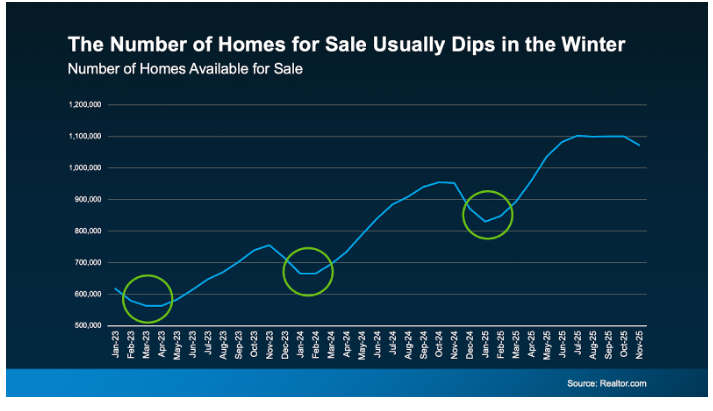
This seasonal dip matters. When fewer homes are available, each listing naturally gets more attention. Buyers aren’t comparing dozens of similar options or bouncing between open houses every weekend. They’re spending more time evaluating the homes that are on the market.
Even though today’s inventory levels may be higher than they were in recent years, they’re still lower than what many would consider a “normal” market. And as winter sets in, supply often tightens further.
That shift can work in your favor, especially if you list while other homeowners are stepping back and before spring inventory ramps up again.
Who Selling Your Home in Winter Tends to Work Best For
Selling your home in winter isn’t the right move for everyone. But it can be a strong fit if you value focus over volume. Winter sellers are often homeowners who:
- Are relocating for work or personal reasons
- Want to avoid competing with a flood of spring listings
- Prefer more serious conversations over casual interest
- Value predictability and clearer timelines
This season tends to attract buyers who aren’t browsing for fun. They’re often working within real deadlines.
Winter Buyers Are Often More Motivated Than You Think
Another overlooked advantage of selling your home in winter is buyer intent. Many winter buyers are navigating real-life changes:
- A job relocation
- A lease ending
- A growing family
- A major life transition
They’re not just testing the waters. They’re actively looking because they need to move. That often means fewer “just looking” showings, more prepared buyers, and faster decision-making.
And because inventory typically drops this time of year, those buyers have fewer options to choose from. When a home is priced thoughtfully and presented well, it has a better chance of standing out.
Practical Considerations When Selling Your Home in Winter
Selling your home in winter does come with a few unique considerations. Knowing what they are helps set realistic expectations and reduces unnecessary stress.
Presentation Still Matters, Just Differently
Shorter days and colder weather mean buyers experience your home differently. Simple adjustments can make a meaningful impact, such as:
- Prioritizing lighting to keep spaces bright and welcoming
- Making sure walkways and entrances are safe and clear
- Creating a warm, comfortable indoor atmosphere
The goal isn’t to stage perfection. It’s to help buyers picture themselves living there comfortably during all seasons.
Pricing Is About Alignment, Not Pressure
Winter pricing isn’t about cutting corners or racing to the bottom. It’s about clarity. A thoughtful pricing strategy considers local inventory trends, recent comparable sales, and seasonal buyer expectations.
Homes priced with intention (not optimism or urgency), tend to attract steadier interest, regardless of the time of year.
A Calmer Pace Can Be a Hidden Benefit
With fewer transactions happening at once, winter can actually feel more manageable.
Real estate professionals involved in the process often have more availability, which can lead to:
- More responsive communication
- Smoother coordination
- Less feeling of being rushed
For many sellers, that calmer pace makes the experience feel more controlled and less overwhelming.
Common Myths About Selling Your Home in Winter
- MYTH: “No one buys homes in winter.” People buy homes year-round. Life changes don’t follow a seasonal schedule.
- MYTH: “You’ll automatically get less for your home.” Price outcomes depend on many factors (location, condition, and demand), not just the month on the calendar.
- MYTH: “Winter sales are harder.” They’re different, not harder. Often more focused, with fewer distractions.
Why This Matters Right Now
It’s easy to get caught up in waiting for the next season, the next shift, or the next “better” moment. But your situation exists now.
Winter may not have the same buzz as spring, but that’s exactly why it can work in your favor. Less competition. More motivated buyers. And a better chance for your home to stand out.
A Gentle Next Step
If selling your home has been on your mind, winter can be a worthwhile time to explore, not commit, and just understand.
You don’t need to decide everything today. Learning how seasonal dynamics affect your options can help you choose what fits your life and timeline best.
See if now is the right time to sell. Explore your options, gather information, and move forward only when it feels clear, not rushed.
Let’s Chat.
Are you ready to navigate the real estate market with confidence? Contact us today to discuss how you can take advantage of current market opportunities.
Michelle Oddo
Mortgage Wealth Advisor, The Oddo Group
michelle.oddo@goluminate.com
(303) 961-6906
Not Sure If You’re Ready to Buy a Home?
Not Sure If You’re Ready to Buy a Home? Ask Yourself These 5 Questions
Deciding whether you’re ready to buy a home can feel overwhelming, especially if you’re hoping to make a move in the next year. Between mortgage rates, home prices, economic headlines, and your own finances, it’s easy to feel stuck in analysis mode.
Here’s the good news: buying a home isn’t about perfectly timing the housing market. It’s about understanding your readiness. Your income, goals, and financial stability matter just as much, if not more, than what’s happening nationally.
Instead of asking, “Is this the right time to buy?” a better question is: “Am I personally ready to become a homeowner?”
These five questions can help you find clarity.
1. Do You Have Stable Income?
One of the first things lenders look at when reviewing a mortgage application is income stability, and for good reason. Buying a home is a long-term commitment, and consistent income provides the foundation for managing monthly mortgage payments and homeownership costs.
That doesn’t mean you need to be in the same role forever. But having a reliable job, a predictable income, or a steady self-employment history can give you confidence as you take this step.
Why it matters: Stable income supports mortgage approval and long-term affordability.
2. Do You Know What You Can Afford Each Month?
Affordability isn’t just about how much house you want, it’s about what fits comfortably into your real-life budget. That includes:
- Monthly mortgage payments
- Existing debts
- Everyday expenses
- Lifestyle priorities
This is where a mortgage pre-approval becomes incredibly helpful. A trusted lender can walk you through:
- How much you may qualify to borrow
- Current mortgage rate options
- Estimated monthly payments
- Closing costs and upfront expenses
Why it matters: Knowing your numbers helps you shop confidently and avoid overextending.
3. Do You Have an Emergency Fund?
Homeownership comes with unexpected moments: repairs, maintenance, or life changes you can’t always plan for. That’s why having a financial cushion matters.
Many financial experts recommend setting aside enough savings to cover several months of expenses, including your mortgage payment. This helps protect you if something unexpected happens, like a job change or medical expense.
Why it matters: An emergency fund adds stability and peace of mind after you buy.
4. How Long Do You Plan to Stay in the Home?
Buying a home typically makes the most financial sense when you plan to stay put for several years. That’s because upfront costs like closing expenses take time to balance out as you build equity.
If your life is fairly settled and you expect to stay in the home for at least three to five years, buying may be a smart move. If you anticipate relocating soon for work or family reasons, renting or waiting might make more sense.
Why it matters: Time helps you build equity and offset buying costs.
5. Do You Have the Right Homebuying Team?
You don’t have to figure this out alone. Having a knowledgeable real estate agent and a trusted mortgage lender can make the process feel far more manageable. The right team can:
- Answer your questions honestly
- Help you understand your loan options
- Guide you through the next steps, whether that’s buying now or preparing for later
Why it matters: Expert guidance brings clarity and confidence to big decisions.
Bottom Line: Readiness is Personal
Buying a home isn’t about checking every box perfectly; it’s about understanding where you are and what makes sense for your future.
If you’re wondering whether now is the right time to buy, a simple conversation can go a long way. At Luminate Bank, we’re here to help you explore your options, understand your numbers, and decide what’s next—on your timeline.
Let’s talk about what homeownership could look like for you.
Let’s Chat.
Are you ready to navigate the real estate market with confidence? Contact us today to discuss how you can take advantage of current market opportunities.
Michelle Oddo
Mortgage Wealth Advisor, The Oddo Group
michelle.oddo@goluminate.com
(303) 961-6906
Financial Clarity in 2026
How You’re Creating Financial Clarity in 2026 Without Starting Over
One of the biggest myths about improving your finances is that you need a clean slate to make progress. A new year. A blank budget. A complete reset.
But that’s not what’s actually happening as people move into 2026.
Instead of starting over, you’re likely looking at what you already have and asking a more practical question: How can this be easier to manage? Financial clarity today isn’t about erasing the past. It’s about creating better structure around your real life.
These questions are designed to help you simplify your finances, improve cash flow, and create real breathing room without undoing the progress you’ve already made.
Why Structure Creates Clarity
When your finances feel heavy, it’s rarely about one big mistake. It’s usually the result of too many moving pieces competing for your attention. Multiple payments. Different due dates. Constant decisions.
Clarity starts to show up when things are more predictable. Fewer payments to track. Clear timelines you can actually plan around. Systems that work in the background instead of demanding daily effort. Whether you’re managing everyday household bills, credit cards, or long-term debt, structure reduces friction, and friction is often where stress lives.
The Power of Fewer Due Dates
Every due date creates a decision. Did you pay it? Is it coming up? Do you need to move money around?
When you reduce the number of those decision points, something subtle but powerful happens. Payments become more consistent. Missed deadlines are less likely. And the mental noise around money starts to quiet down.
That’s why many people in 2026 are pairing consolidation with automation. One simplifies the number of obligations. The other removes the need to think about them constantly. Together, they create breathing room.
Using the Tools You Already Have, More Intentionally
For many bank customers, financial clarity doesn’t require new products. It comes from using existing tools with more intention. Consolidating checking and savings accounts can make cash flow easier to see at a glance. Automated transfers help ensure priorities are funded before money gets spent. Clear spending categories replace guesswork with visibility.
You can explore how Luminate’s personal banking tools support simplicity and day-to-day clarity here with our Brighter Checking and Digital Tools.
If you’re a homeowner, clarity may look different, but the goal is the same. You might be exploring how to use home equity strategically, keeping a low mortgage rate intact, or aligning other debts with longer-term plans instead of short-term pressure.
You can learn more about home equity and mortgage options on our website, but feel free to contact us with any specific questions.
Why the Lowest Rate Isn’t Always the Best Answer
As 2026 begins, more people are choosing manageability over optimization. The lowest rate on paper doesn’t always lead to the best outcome if it introduces rigidity, risk, or added stress.
What matters more is fit. Does your financial setup support how you live? Does it adapt when things change? Does it reduce pressure instead of adding to it?
Clarity isn’t about chasing headlines. It’s about creating a system that actually works for you.
A Calmer Way Forward
This isn’t about perfection or erasing everything and starting from scratch. It’s about building a financial setup that supports your life, adjusts as your needs change, and gives you room to breathe.
That’s what financial clarity in 2026 really looks like. If you’re ready for a brighter financial future, we’re ready to help.
Let’s Chat.
Are you ready to navigate the real estate market with confidence? Contact us today to discuss how you can take advantage of current market opportunities.
Michelle Oddo
Mortgage Wealth Advisor, The Oddo Group
michelle.oddo@goluminate.com
(303) 961-6906
5 Questions Before Lowering Monthly Payments
5 Questions to Ask Yourself Before You Try to Lower Your Monthly Payments in 2026
January is full of financial noise. Advice, resolutions, and quick fixes show up everywhere this time of year. But if your real goal for 2026 is lower monthly payments and more peace of mind, the smartest move isn’t rushing into change; it’s asking better questions first.
These questions are designed to help you simplify your finances, improve cash flow, and create real breathing room without undoing the progress you’ve already made.
1. Which Monthly Payments Actually Create Stress for You?
The payment that weighs on you most isn’t always the one with the largest balance. Often, it’s the one that feels unpredictable, high-interest, or poorly timed with your income.
You might notice stress coming from a payment that carries a higher rate, hits at the wrong time of the month, or forces you to constantly check your account balance. That feeling matters. Financial stress is often your first signal that something could be structured more efficiently.
Lowering monthly payments starts by identifying which obligations are creating pressure, not just which ones look biggest on paper.
2. How Predictable Does Your Cash Flow Feel Month to Month?
You don’t need a perfect budget to feel in control. What you need is predictability.
When your income and expenses don’t line up cleanly, even reasonable payments can feel overwhelming. This is where visibility and automation make a real difference. The easier it is for you to see what’s coming, the less mental energy you spend managing money day to day.
Digital banking tools that help you track balances, automate payments, and understand cash flow patterns can help reduce that constant low-level stress.
3. Are You Simplifying Your Finances, or Just Rearranging Them?
Lower payments should make your financial life easier, not more complicated.
Before making changes, ask yourself whether the solution reduces the number of accounts, due dates, and decisions you’re managing each month. If it introduces more moving pieces, the relief may be temporary.
True debt consolidation and payment restructuring should bring clarity, not more things to track.
4. Does This Solution Work for the Long Term?
It’s easy to focus on immediate relief, but long-term stability matters more.
Ask whether the structure you’re considering supports where you’re headed next. The best solutions are the ones that give you consistency, flexibility, and fewer monthly decisions over time, not ones that require frequent adjustments.
Lower monthly payments should make your financial life feel steadier, not more fragile.
5. Will This Improve Your Life, Not Just the Math?
The best financial decisions don’t just improve numbers on a screen. They improve how you feel.
Real progress looks like fewer financial check-ins, less second-guessing, and more confidence in your day-to-day money decisions. That’s the kind of breathing room many people are prioritizing heading into 2026.
If you’re a homeowner, tools like a HELOC or a strategic refinance may help lower monthly obligations and simplify your cash flow when they align with your long-term goals.
Asking the right questions now can help you move into 2026 with more clarity, fewer financial stress points, and a structure that actually supports your life. Next week, we’ll explore how people are creating simplicity and flexibility, without starting over or taking a step backward.
Let’s Chat.
Are you ready to navigate the real estate market with confidence? Contact us today to discuss how you can take advantage of current market opportunities.
Michelle Oddo
Mortgage Wealth Advisor, The Oddo Group
michelle.oddo@goluminate.com
(303) 961-6906
Debt Consolidation Explained
Debt Consolidation Explained: A Tool for Simplicity, Not a Sign of Trouble
When you hear the phrase debt consolidation, it often carries an unnecessary weight. It sounds like something you only consider when your finances have gone off the rails.
But as 2026 approaches, that’s not how most people are thinking about it. And you shouldn’t either.
Instead of asking whether they’ve done something wrong, more people are asking a quieter, more practical question: Could managing my money take less effort than it does right now?
Between rising everyday costs, multiple due dates, and a growing stack of “manageable” payments, finances can start to feel cluttered, even when everything is technically under control. Debt consolidation has become a way to simplify that complexity, not a signal of financial failure.
What Debt Consolidation Actually Means for You
At its simplest, debt consolidation means combining multiple debts into fewer payments so your financial life is easier to manage.
That might mean replacing several credit card payments with one, or moving higher-interest balances into a structure with clearer terms and a more predictable monthly obligation. The goal isn’t to avoid paying what you owe. The goal is to make your obligations easier to track, easier to plan for, and easier to live with.
For many households, the biggest benefit isn’t mathematical, it’s mental. Fewer payments often mean fewer reminders, fewer due dates to juggle, and less second-guessing whether something is about to slip through the cracks.
Why Consolidation Is Increasingly a Proactive Move
A growing number of people who explore debt consolidation are not behind on their bills. They’re current. They have decent credit. They’re doing “all the right things.”
What they don’t have is simplicity.
Over time, debt tends to accumulate gradually: a credit card here, a car loan there, a balance transfer, a personal expense. Each decision made sense in the moment. But together, they create a system that requires constant attention.
Consolidation becomes appealing not because something is broken, but because maintaining the status quo feels unnecessarily complicated. For many, it’s a way to regain control before stress enters the picture, not after.
Clearing Up the Biggest Misconceptions: Myth vs. Reality
Myth: Learning about debt consolidation means you’re committing to it.
Reality: Exploring your options doesn’t lock you into a decision. It simply gives you information. Understanding how consolidation works allows you to evaluate it calmly, rather than feeling forced into a choice later when stress is higher.
Myth: You should wait until finances feel urgent before looking at solutions.
Reality: The best time to understand your options is before things feel tight. When you’re proactive, you have more flexibility, more choices, and more control over how you structure your finances.
Myth: Lowering monthly payments is the only goal that matters.
Reality: Monthly payment relief is important, but predictability and peace of mind matter just as much. Knowing what’s coming out of your account, and when, can create breathing room even if the numbers don’t change dramatically.
Myth: There’s a single “right” answer for everyone.
Reality: The right solution depends on your income, your goals, and how you want your money to function in your life. For some, consolidation makes sense. For others, better cash-flow management or account structure delivers the clarity they’re looking for.
When you understand your options ahead of time, decisions stop feeling reactive. You gain the space to choose what actually supports your financial life, rather than rushing into whatever feels like the fastest fix.
Choosing the Right Path Depends on Your Situation
There’s no universal solution when it comes to debt consolidation. The right approach depends on what kind of debt you have, how stable your income is, and what you’re trying to improve. Whether that’s lowering monthly payments, simplifying cash flow, or reducing interest over time, just know that every situation looks different.
For example, a homeowner’s home equity can sometimes be used strategically to consolidate higher-interest debt while keeping an existing mortgage rate intact. A Home Equity Line of Credit (HELOC), for example, can offer flexibility and control while allowing you to restructure balances more efficiently.
For others, consolidation dhttps://www.luminate.bank/refinancingoesn’t start with a loan at all. Improving how your checking and savings accounts are set up (i.e., automating payments, smoothing cash flow, and increasing visibility), can make a meaningful difference in how manageable your finances feel day to day.
Understanding Your Options Creates Breathing Room
It’s important to remember that learning about debt consolidation doesn’t lock you into a decision. It simply gives you context.
When you understand how consolidation works, what it can and can’t do, and how it fits into your broader financial picture, you’re less likely to make reactive choices later. You gain the ability to decide from a place of clarity instead of pressure.
In the next post, we’ll walk through the key questions you’ll want to ask before trying to lower your monthly payments in 2026. That way, you can determine whether consolidation, restructuring, or simply better cash-flow management is the right move for you.
Let’s Chat.
Are you ready to navigate the real estate market with confidence? Contact us today to discuss how you can take advantage of current market opportunities.
Michelle Oddo
Mortgage Wealth Advisor, The Oddo Group
michelle.oddo@goluminate.com
(303) 961-6906